Recently, I was trying to deploy an Azure App Service which was in need for a couple of certificates, which are stored in Azure Key Vault.
Our ARM template looked very similar to the one below in order to install & configure the certificates in our App Service.
"resources": [
    {
        "type": "Microsoft.Web/certificates",
        "name": "[parameters('certificateName')]",
        "apiVersion": "2019-08-01",
        "location": "[parameters('existingAppLocation')]",
        "properties": {
            "keyVaultId": "[parameters('existingKeyVaultId')]",
            "keyVaultSecretName": "[parameters('existingKeyVaultSecretName')]",
            "serverFarmId": "[parameters('existingServerFarmId')]"
        }
    },
    {
        "type": "Microsoft.Web/sites",
        "name": "[parameters('existingWebAppName')]",
        "apiVersion": "2019-08-01",
        "location": "[parameters('existingAppLocation')]",
        "dependsOn": [
            "[resourceId('Microsoft.Web/certificates', parameters('certificateName'))]"
        ],
        "properties": {
            "hostNameSslStates": [
                {
                    "name": "[parameters('hostname')]",
                    "sslState": "SniEnabled",
                    "thumbprint": "[reference(resourceId('Microsoft.Web/certificates', parameters('certificateName'))).Thumbprint]",
                    "toUpdate": true
                }
            ]
        }
    }
]
When deploying said template, we quickly received a message the deployment had failed.
Resource Microsoft.Web/certificates ‘[myCert]’ failed with message
{ “Code”: “BadRequest”, “Message”: “The service does not have access to ‘/subscriptions/[subscription]/resourcegroups/[resourcegroup]/providers/microsoft.keyvault/vaults/[myVault]’ Key Vault. Please make sure that you have granted necessary permissions to the service to perform the request operation.”, “Target”: null, “Details”: [
{
"Message": "The service does not have access to '/subscriptions/[subscription]/resourcegroups/[resourcegroup]/providers/microsoft.keyvault/vaults/[myVault]' Key Vault. Please make sure that you have granted necessary permissions to the service to perform the request operation."
},
{
"Code": "BadRequest"
},
{
"ErrorEntity": {
"ExtendedCode": "59716",
"MessageTemplate": "The service does not have access to '{0}' Key Vault. Please make sure that you have granted necessary permissions to the service to perform the request operation.",
"Parameters": [ "/subscriptions/[subscription]/resourcegroups/[resourcegroup]/providers/microsoft.keyvault/vaults/[myVault]"
],
"Code": "BadRequest",
"Message": "The service does not have access to '/subscriptions/[subscription]/resourcegroups/[resourcegroup]/providers/microsoft.keyvault/vaults/[myVault]' Key Vault. Please make sure that you have granted necessary permissions to the service to perform the request operation."
Read more →
In my last post
, I described how to create a Hugo website
and what I did to migrate from my Miniblog platform, along with some details on how to create the build & deployment pipeline.
I started by deploying my Hugo websites to a regular Azure App Service. This is a full-blown web application platform. It’s a bit too overpowered for hosting a simple, static, website. As I mentioned in the earlier post, it makes a lot more sense to host static websites on an Azure Storage Account with the Static website hosting
. The main reason I postponed this is that I had some issues creating my routing rules.
Moving to static site hosting ASAP
After having migrated to Hugo & the App Service hosting model, I quickly noticed moving to the static site hosting option was quite important.
Every time my deployment pipeline was deploying the files to the App Service, the site became unavailable.

The pages returned a 404 and when navigating to the root site, the site was just empty.
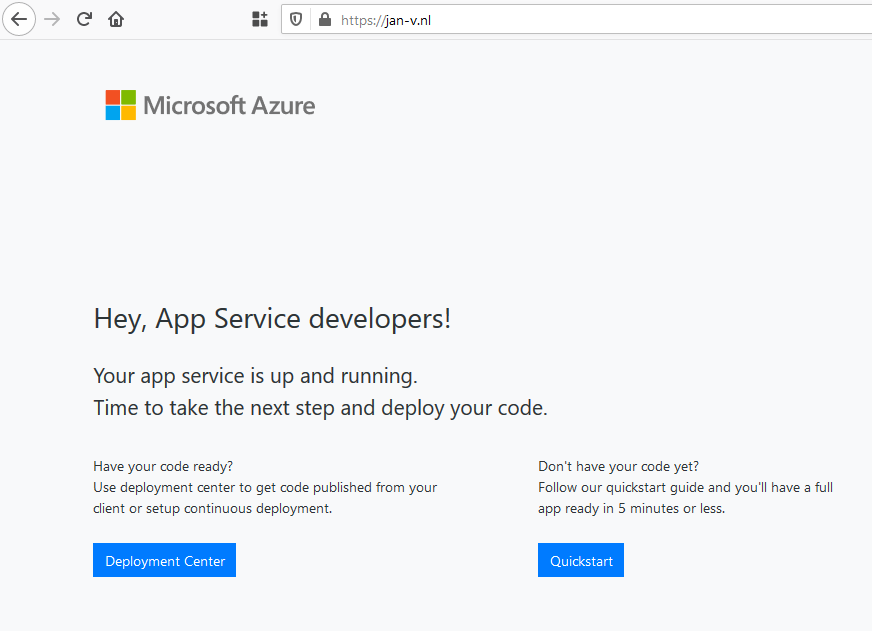
This is bad, really bad.
Of course, I can solve this by deploying the site to a Staging slot and swap with Production when ready. This is quite doable, but not a path I wanted to pursue.
Read more →A couple of weeks ago, I was tasked to implement authentication between the services we have in our Azure landscape. I knew this can be done by using the Managed Identity, as we were doing this on a project I was involved with in the past.
However, I had never actually done this myself. Most of the time the System Administrators were configuring everything and I just had to copy-paste some Guids in a configuration file. After doing some digging into the matter, it was a bit harder to set this up as I had expected at the start.
Lucky for me, Joonas Westlin
has some excellent posts on the matter which have helped me enormously. He was also able to help me out on Stack Overflow when I was stuck
and couldn’t find out why the authentication wasn’t working correctly.
Much of what I’ll be writing down here will be similar to Joonas his posts on the matter. I’ll be using some different wording.
The posts I’ve used to learn this stuff were:
Any now and then you have to make some major changes to the ARM templates of the project you’re working from. While this isn’t hard to do, it can become quite a time-intensive if you have to wait for the build/deployment server to pick up the changes and the actual deployment itself.
A faster way to test your changes is by using PowerShell
or the Azure CLI to deploy your templates and see what happens.
However, when using linked templates
this can become quite troublesome as you need to specify an absolute URL where the templates can be found. At this moment in time, linked templates don’t support using a relative URL
. While this issue currently is Under review, we still might want to test our templates today. So how to proceed?
Well, you will have to deploy your linked ARM templates to some (public) location on the internet. For your side projects, a GitHub repository might suffice, but for an actual commercial project, you might want to take on a different approach.
How to do this in Azure DevOps
For one of the projects I’m working on, I’m using the Azure Blob File Copy step in the deployment pipeline to copy over all of the ARM templates to a container in a Storage Account.
Read more →I started working on some internal web applications for a customer. For these types of applications, it makes a lot of sense to use Azure Active Directory to authenticate users and use their AAD groups/roles to authorize them on specific pages.
I wanted to authorize users by the AAD groups they are placed in. Some users can access Production data, while others are only allowed to access data from the Test environment, all based on the groups they are in. Because this is already configured by our system administrators, I want to use these groups for my application(s) also.
This sounds easy enough, and it is, but you have to do some manual work in Azure Active Directory to make this possible. It took me too much time for my liking, so I hope this post helps others (and myself) in the future.
One of the first things you need to do is create a new App Registration in the AAD and give it permission to User.Read.All to read the users’ claims.
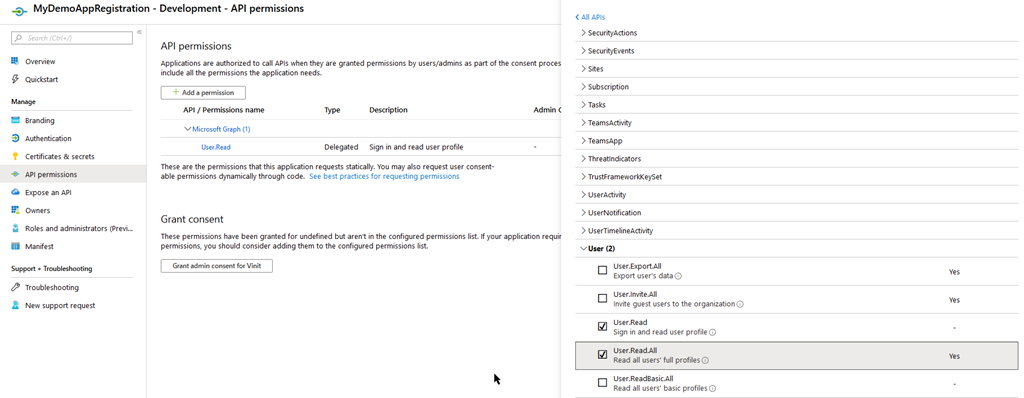
This requires consent from your Administrator, so make sure they are available or you have enough permissions yourself to do this.
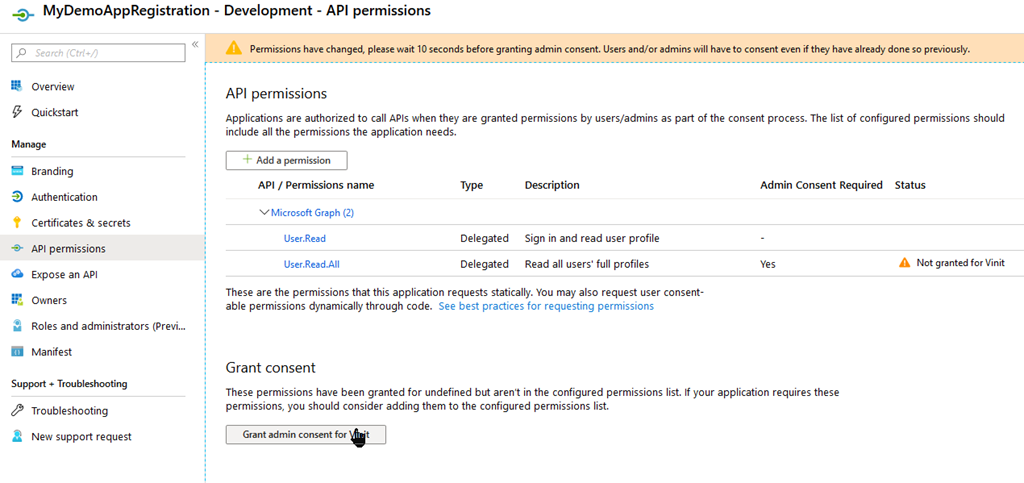
When this is set up correctly, head to the Manifest blade.
Read more →A couple of weeks ago I was busy creating some proof of concept applications using Blazor, which was still labeled preview at the time.
To get all of this deployed and working in an Azure App Service, I needed the preview .NET Core runtime installed. An App Service is a PaaS offering, which means you don’t have any influence on what version of the software gets installed on the underlying system.
Lucky for me, there’s a site extension which enables us to install the latest .NET Core version on an App Service.
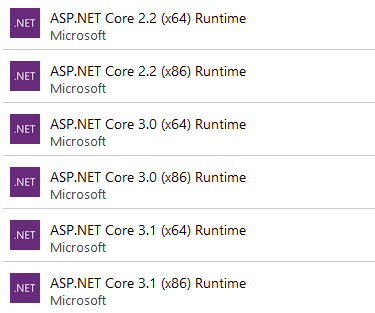
At the time of this blogpost, the 3.0 runtime still isn’t installed on App Services and the 3.1 runtime is still in preview. However, with this extension, you can install whatever you like and use the new features.
It’s, of course, also possible to install these extensions via an ARM template. The following excerpt installs the 3.0 x64 runtime to your App Service.
{
"type": "siteextensions",
    "name": "AspNetCoreRuntime.3.0.x64",
    "apiVersion": "2015-04-01",
    "location": "[resourceGroup().location]",
    "properties": {
        "version": "[variables('aspnetcoreVersion')]"
    },
    "dependsOn": [
        "[resourceId('Microsoft.Web/Sites', variables('webAppServiceName'))]"
    ]
}
As you can see I’m still stating which aspnetcoreVersion I want installed. With this property you can specify which Preview or RC version you need installed.
A very useful extension to use if you want to be on the latest runtime or if it takes too long for your liking for the App Services team to update the .NET version on the underlying systems.
Read more →A couple of weeks ago I’ve passed both the AZ-300 and AZ-301 exams. You’re required to pass both of these exams in to get the Azure Solutions Architect Expert certification. After posting a tweet I got a lot of responses asking if I had any pointers on what to learn. Instead of responding to each person individually it makes more sense to share what I’ve used to study and hopefully it’s helpful to others also.
When going through the list of [Skills measured](https://www.microsoft.com/en-us/learning/azure-solutions-architect.aspx?WT.mc_id=AZ-MVP-5003246) you quickly notice this certification covers a lot of stuff in the Azure ecosystem. Everything from Azure Active Directory to Azure App Services and from storage accounts to multi-factor authentication for users. You need to know everything!
At my day job I’m doing a lot of stuff within the Azure ecosystem but mainly focus on PaaS solutions, like App Services, Functions, Logic Apps, Service Bus, Event Grid, etc. All of the other stuff like IaaS, CaaS, security, AAD, hybrid solutions, site recovery are topics I don’t have a lot of experience with.
So while there might be stuff I didn’t know in the PaaS ecosystem, I knew I had to focus my learning on all of the other stuff as most of it is/was a black box to me.
Read more →If you’ve read my earlier post on authentication of actions invoked in a Microsoft Teams MessageCard
, you’ve probably seen the only useful information we get in the user’s token is the Object Id (oid).
{
  "iat": 1560799130,
  "ver": "STI.ExternalAccessToken.V1",
  "appid": "48afc8dc-f6d2-4c5f-bca7-069acd9cc086",
  "sub": "bc6c3ca0-5acd-4cd4-b54c-f9c83925e7e3",
  "appidacr": "2",
  "acr": "0",
  "tid": "4b1fa0f3-862b-4951-a3a8-df1c72935c79",
  "oid": "b26c3c10-5fad-4cd3-b54c-f9283922e7e2",
  "iss": "https://substrate.office.com/sts/",
  "aud": "https://serverlessdevops.azurewebsites.net",
  "exp": 1560800030,
  "nbf": 1560799130
}
While this is nice, it doesn’t really tell us much.
However, because we have the object id, we can use this to query the Azure Active Directory to check up on who this user actually is and implement some authorization logic with it.
However, when I was searching for a workable piece of code describing how to access AAD and retrieve users from it, the information was�not very useful. In the end, I have found something workable and I’ll be sharing my solution in this post.
How to set up my application in AAD
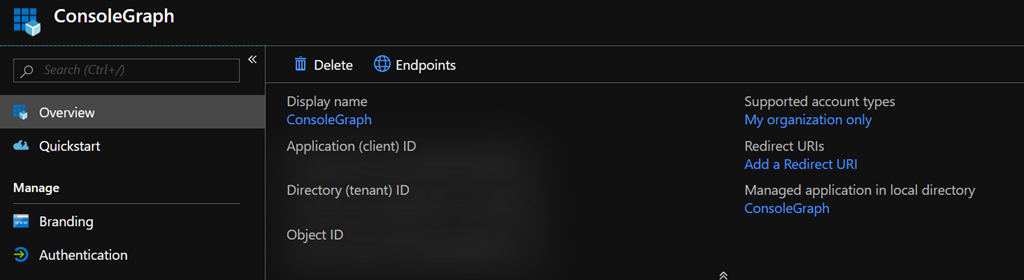
In order to do something inside AAD, you need to have an identity over there. Since we’re creating an application (console or API), we need to create an Application Registration.
To do this, navigate to your Azure Active Directory blade inside the Azure Portal and create a new App registration. I’ve called mine ConsoleGraph because I’m creating a console application to query my AAD.
Read more →Being able to create Message Cards or Actionable Messages in Microsoft Teams via a Logic App
or an Azure Function
is great. Especially if you can use this to invoke logic on your API and update the message in the Teams channel
.
However, you don’t want everyone to invoke a management API endpoint you’ve exposed to ‘do stuff’ in your cloud environment. Normally, you’d want to authenticate if the user pressing the button (read: invoking the endpoint).
Lucky for us, this is very doable when invoking the endpoint via a Teams MessageCard/Actionable Message.
The token
Because Microsoft Teams is part of the Office 365 suite, you will be logged in as a user on the tenant. Therefore, the software has a user context and is able to pass this along to your API via a JWT Bearer token
.
If you log in to the web client of Microsoft Teams (https://teams.microsoft.com
) with your favorite browser you’ll be able to find the token which belongs to you.
In order to test this, I’ve created a new MessageCard in my Teams channel with 1 potentialAction which will invoke an Azure Function.
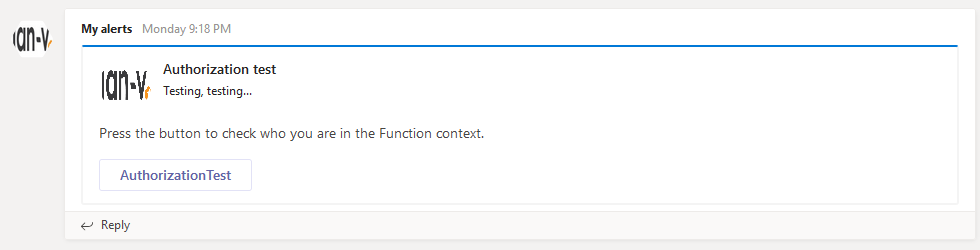
If you open up the network tab of your browser’s Developer Tools and press the AuthorizationTest button you’ll see the request is made to a Teams endpoint called executeAction with a bearer token in the Authorization header.
Read more →In my latest post, I’ve shown you how you can use Azure Functions in your Microsoft Teams flow to handle errors in your environment
. This stuff works great in a couple of projects I’ve worked on, but what would be even more awesome is to reply to a message in Teams when an action has completed after a button is pressed.
Well, replying & modifying the original message with a status update is quite possible and I’ll show you how in this post.
How do I send a reply to Microsoft Teams?
In the image below you can see a message having posted on my Teams channel and a reply is posted.
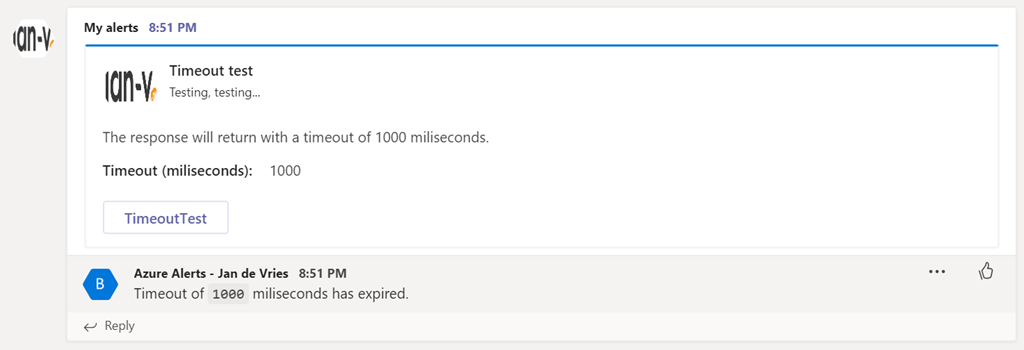
This reply has been sent from my Azure Function. If you want to do this, you need to send a HttpResponseMessage with a status code 200 and a specific header value. This header value is CARD-ACTION-STATUS and the value will be the message which you will see in the reply.
The code for this will look something similar to the following.
public static async Task<HttpResponseMessage> Run(
	[HttpTrigger(AuthorizationLevel.Function, "post", Route = null)] HttpRequest req,
	ILogger log)
{
	// Do your stuff...

	var result = new HttpResponseMessage
	{
		Headers =
		{
			{ "CARD-ACTION-STATUS", $"Timeout of `{request.Timeout}` miliseconds has expired."},
		},
		StatusCode = HttpStatusCode.OK
	};


	return result;
}
That’s all there is to it in order to send a single reply to your message.
Read more →